Do I Expect Too Much from Men?
A guest post by my husband

[As you might imagine, my husband and I often talk about misogyny and the role men can play in stopping it. I know there are a lot of good and safe men out there. Christopher is one of them. Because he has integrity and a unique vantage point, I asked him to weigh in for this week’s post.]
The high school boys’ locker room was a foreboding place. Back in the 1970s the group shower was customary and dreaded by some. The snapping of towels, the mocking laughter, the body odor. This was the place boys would be boys. This was the place where I learned what women were for. Boys spoke of and denigrated girls’ and women’s body parts, bragged about conquests, fabricated their own prowess, and dared others to contradict them. Protective feelings about my grandmother, my aunts, my mother, my sister, my cousins, the actual girls being named were to be set aside. Caring about others was sissy stuff in this world.
Even as an insecure adolescent, I could detect that the chorus of female objectification had little to do with the females themselves—their quality, their beauty, their sensuousness—but rather was put on for the male audience. The idolized and dominated “she” wasn’t a person in that boy’s eyes, but a strategy to be used to gain the attention and respect of the other boys. Degrading her won him them. Male approval or the specter of male rejection is what seemed to matter most to these boys.
My penchant for irony may have heightened or distorted my perceptions. What did I know? I was an also-ran-a-lot-slower who spoke not a word of protest. A shadowy boy in the back of the locker room who would rather go through his whole day smelly and sweaty than enter that toxic male whirlpool. I hadn’t their courage—or so I thought. So I put on my street clothes and went to my next class unshowered. Inferior. Afraid. Disgusted. Perplexed about why the gym teachers said nothing.
When I ask whether I expect too much from men, here’s what I mean. When I bring up this memory to discuss (which I have never done), I would expect any group of men to feel shame about such immature hi-jinks, especially if they are faithful partners to wives, fathers of daughters, brothers of sisters, or just respectful members of a community. I would expect them to express their own regrets and share lessons learned. I would expect to discover I wasn’t the only silent boy in a locker room wishing that some guy would shut his friggin mouth. I would expect zero defensiveness and zero excuses. Having gained wisdom from the past, I might expect them to interrupt a friend or work colleague or even a boss should the slightest hint of female objectification in a joke or personal story raise its Medusa head.
Am I expecting too much from men?
Even when the news is full of female victimization at the hands of blustery men—men of business, men of sport, men of state, men of medicine, men of church—men who always plead innocence. Nobody seems to want to talk about this without a “yeah, but” disclaimer. Bring up the subject of how women are treated in American society, and I’m just as likely to hear a despairing, “They’ve got it better than we do,” or a hyperbolic and slippery, “I know—we’re all evil,” or the perennial, “It’s not all men.” To which I might ask, well, how many men is it? Is it 5%? 25%? 50%? Or 0% and women are just making this up? Are we batting in the .400’s or in the .200’s? What are the misogyny stats?
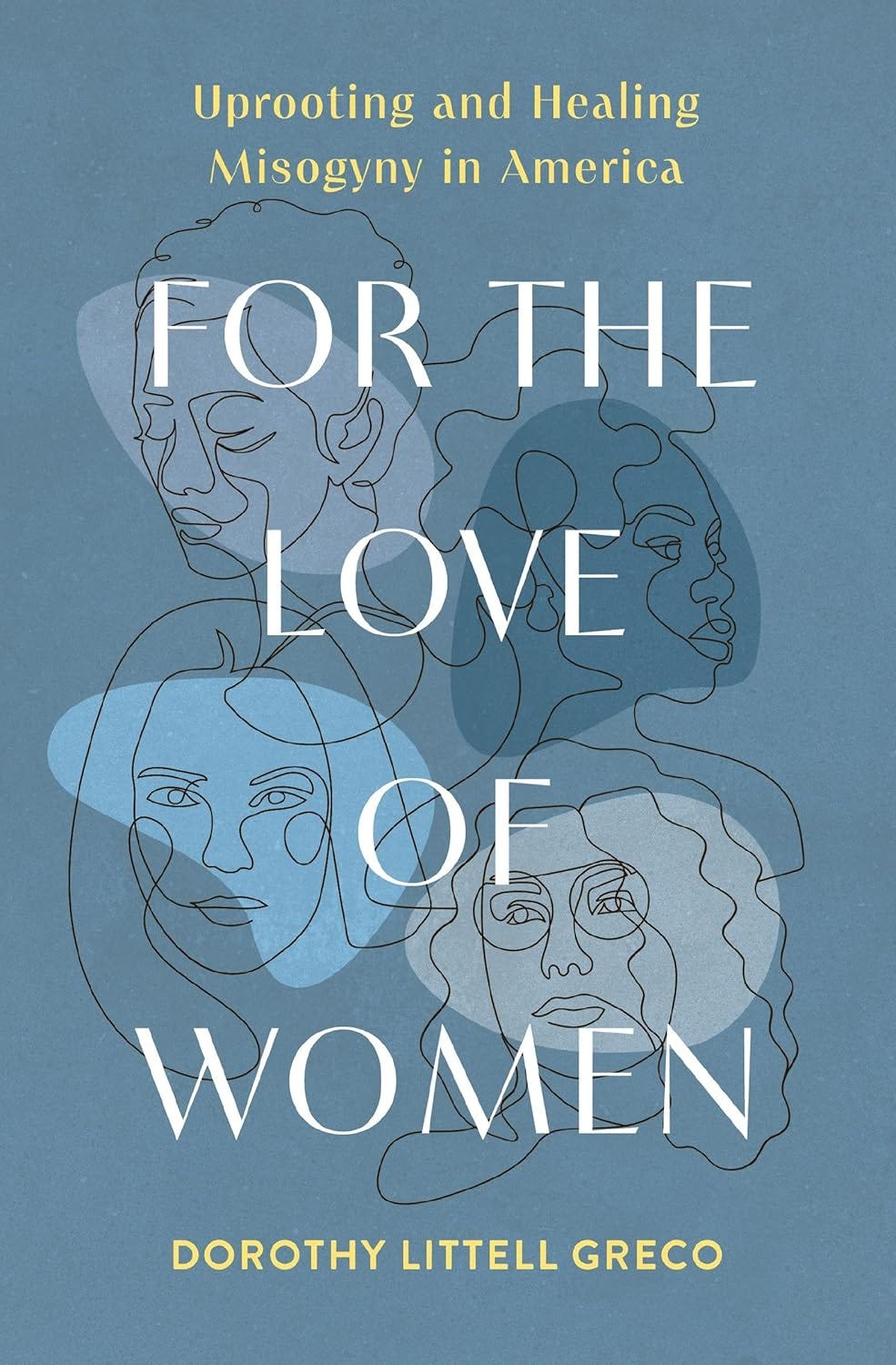
Ah, the m word. Misogyny. Succinctly defined as the hatred of women. My wife Dorothy’s definition in her book, For the Love of Women, is subtler: “A persistent, insidious belief that men’s ideas, wants, needs, and experiences are more important than women’s and that legal, religious, and social systems, as well as intimate relationships, should uphold this principle. This belief system subsequently influences the laws, policies, practices, and ethos of a given culture.”
Misogyny is a word like kryptonite. Say it, and the bravado of supermen deteriorates into bristly defensiveness. “I don’t hate women. I love women. That’s the problem with me.” They may melt into oaths of brotherhood to protect the honor and rights of all men, playing to the male audience. What I hear is the entitlement to that which these men seem most to desire: sexual pleasure with impunity. Regardless of its cost to women and children.
Boys will be boys—and men will remain boys if we let them.
So yes, I guess I expect too much from all men. But if it’s not all men, then what might I expect from one man? What might I expect from one man who may read to the end of this article? Or one man I work with? Or one man I see in church? Or one man who might consider reading my wife’s book? (Or putting that book in the hands of another man who needs to see the stats. They’re there.)
Here’s what I’d like to expect of any man:
Beg your own defensiveness. If you feel it, own it, rather than blame it on the person who may have triggered it. What’s that defensiveness about for you? Is someone actually attacking you or are you imagining it? Are there unresolved actions or words in your past that you haven’t fully explored and interrogated? What parts of you are being misunderstood and not seen by others?
Don’t dismiss human history. The onus is not on women to prove beyond a shadow of a doubt that they have been devalued and mistreated. The onus of proof is on us as men to demonstrate our exceptionalness in the face of persistent male depravity. Through the quality of our character, our words and actions, including not just a willingness to be in this misogyny conversation once, but being one man who will not shut up about it for the love of women, and children, and other men.
Acknowledge your own failures and shortcomings to the women who matter most to you. If that’s too threatening, bring it up to a man who will take your confession seriously rather than slough it off. Even if you don’t know how to do better, you can say, “I see that I don’t love you consistently and I’m sorry.” Seeing and admitting a wrong is the beginning of all worthy amends.
Ask questions of the women in your life and believe their answers. “Do you feel that I value your thoughts and feelings as much as my own?” “Is there something I might do to make more space for you?” “Am I consistently helping you to flourish?” “Is there a question that I should be asking you that I don’t know to ask?”
If in reading this you feel shame or conviction, I encourage you to spend some time in that space rather than ejecting out or pushing your feelings away. To paraphrase Dorothy, discomfort can be the beginning of change. When we as men reckon with the harm we have caused and admit it, we have the capacity to bring healing and right wrongs. And forgiveness is always awaiting us.
Because misogyny is so deeply embedded in American culture, this conversation can seem both overwhelming and hopeless. If it feels that way to me who carries privilege by being male, what must it feel like for women? I recognize the power of intact masculinity every time I hear a man risk his own reputation and status to make space for a woman’s voice, perspective, and/or grievance. By amplifying and supporting women, men are not diminished, because the image of God is not zero sum after all! Perhaps the salient question isn’t do I expect too much from men, but why does society expect so little of us?
I (Dorothy) will be having a Substack Live conversation on male entitlement and how men can help end misogyny with author and speaker Jonathan Walton on Tuesday, March 17, at 8 PM. I hope you will join us.
Please consider subscribing, sharing, and leaving a comment as that helps other readers find my work. You can buy For the Love of Women through the publisher, or via my favorite bookstores, Hearts & Minds and Nooks. (Amazon also carries it but please buy from an independent bookseller when possible.)
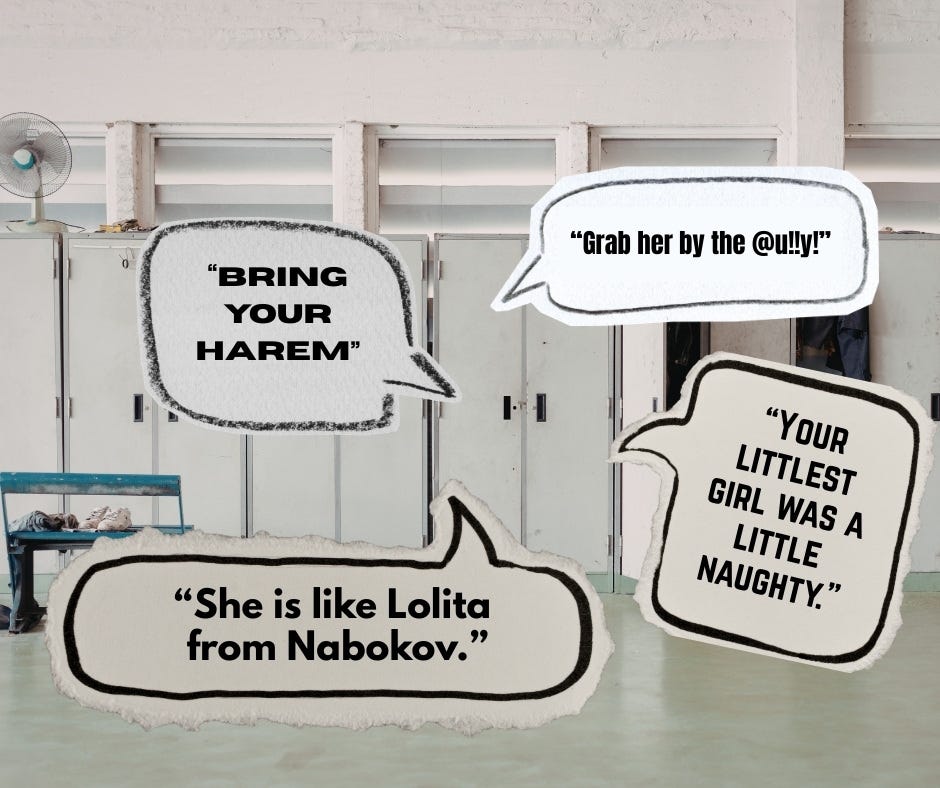
Quotes in header image from the Epstein Files as well as Donald Trump’s comment from the Access Hollywood interview. “Lolita from Nabokov” most likely refers to the 1955 novel by Vladimir Nabokov about a middle-aged man who has a relationship with a 12-year-old girl and sexually abuses her. Locker room photo Ionut Dabija, from Canva.
This is hard stuff. Take care of yourself.
This really resonated with me. I’ve been reading Proverbs with my children and I see how God’s word categorically condemns the type of behavior that’s so often associated with “just being a guy.” God’s word calls all of us to be humble, sober minded, virtuous and full of integrity.
Thank you for this!
Hearing a man speak like this is both healing and hard. Encouraging and discouraging. Healing/encouraging for obvious reasons, and hard/discouraging because so many of us are still living in places (marriages, churches,...etc) where there are no--or very few--such men, even among the ones we've always considered "good."
I have enjoyed your book so far, Dorothy. I will recommend it to friends and others!